Prod 3b blue

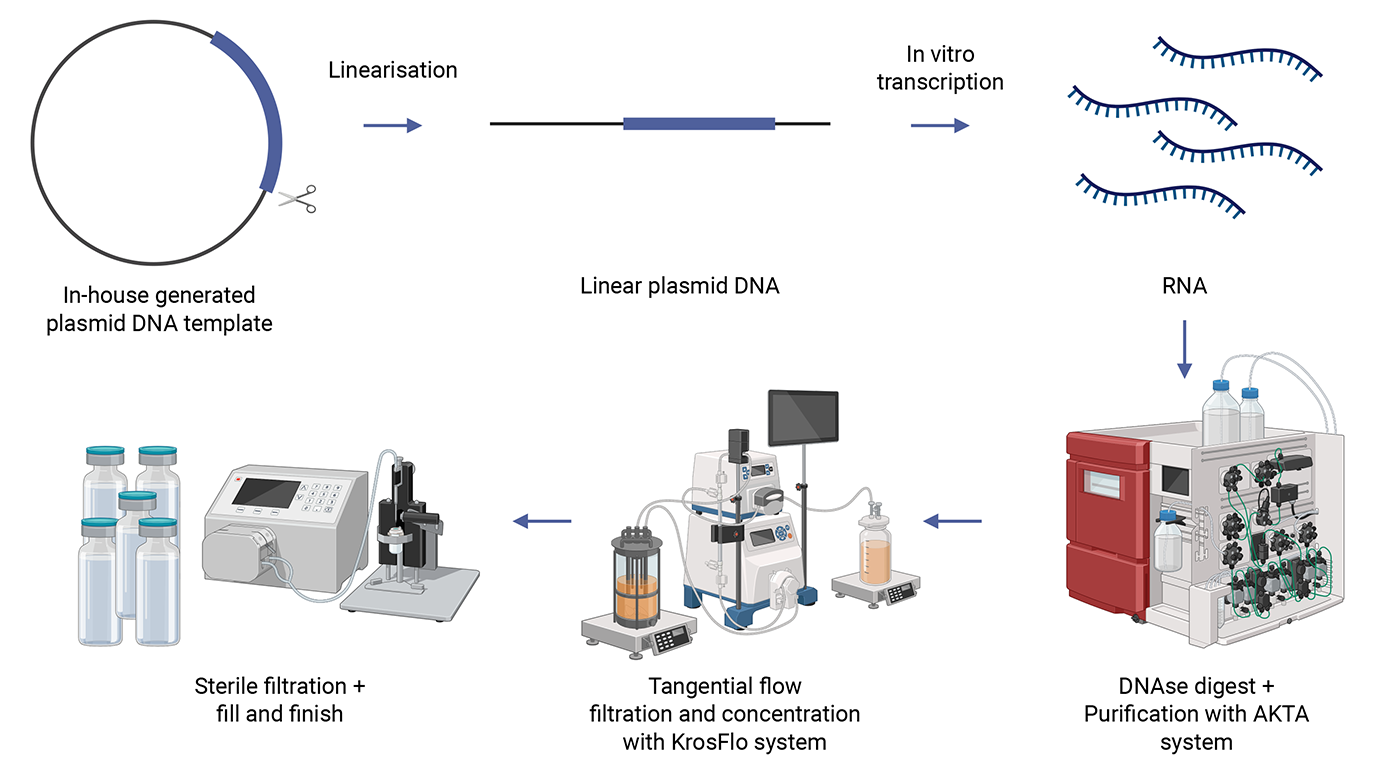
In-vitro transcribed RNA

in vitro transcribed (IVT) RNA for use as starting material or drug substance in iATMP manufacturing

Rna manufacturing process

Midrix-Neo

neoantigen-presenting autologous dendritic cell therapy for NSCLC

Service: Tech transfer, IMPD writing Manufacturing, QC, QP release for phase I clinical trial

Collaborator: Prof. dr. Karim Vermaelen, Prof.dr. Björn Menten, Prof.dr. Francis Impens

completed

Ingels J. et al. Cell Reports Medicine 2024

Here, we report the results of a first-in-human clinical trial in which we explored the potential of an autologous DC vaccine targeting neoantigens as adjuvant therapy in early-stage resected NSCLC patients. The primary endpoint of the trial was safety. Secondary endpoints were feasibility, immunogenicity, and relapse-free survival.

  • An important challenge of Neo-mDC therapy is the extensive coordination required between the different actors and processes (i.e., next-generation sequencing [NGS], immunopeptidomics, bioinformatic analyses, production of the plasmid template, good manufacturing practice [GMP] production of RNA, apheresis of the patient, and finally GMP production of the cell therapy product) in order to streamline the overall production process and time.
  • In the present trial, fully functional, neoantigen-loaded, monocyte-derived DCs were generated in only 4days, which is associated with reduced costs compared to classical 7/8-day DCs due to fewer operator interventions, less consumables, and less occupation time of ultrapure, class B clean rooms dedicated to aseptic processing.
  • Further reduction of costs may be achieved by using fully automated, closed cell-culture systems, of which several platforms are currently being developed and actively explored for chimeric antigen receptor (CAR)-T cell production. The introduction of these systems will enable further reduction in operator interventions and reduce the need for class B clean rooms.

Galsome-Neo

Glycolipid-adjuvanted mRNA lipid nanoparticle cancer vaccine.

Service: Tech transfer, IMPD writing, Manufacturing, QC for toxicity study and phase I clinical trial

Collaborators: Dr. Ine Lentacker, Dr. Rein Verbeke, Dr. Ine Lentacker, Dr. Rein Verbeke, Prof. dr. Stefaan De Smet, Prof.dr. Karim Vermaelen, Dr. Dieter Stevens, Prof.dr. Diether Lambrechts, Prof. Dr. Jeroen Dekervel

Ongoing

Galsome-NEO is a glycolipid-adjuvanted mRNA lipid nanoparticle (LNP) cancer vaccine encoding neo-epitopes for evaluation in a phase 1 study in patients with non-small cell lung cancer. The inclusion of the glycolipid adjuvant, alpha-galactosylceramide (α-GC), within the LNPs not only activates T cells but also engages invariant natural killer T (iNKT) cells, thereby eliciting a multi-faceted anti-tumor immune response.

The Nanomedicine lab at the University of Ghent has developed a glycolipid-adjuvanted mRNA vaccine. The development of the manufacturing process, the manufacturing and QC of the batch for toxicology, was done at the GMP unit of UZGent.

In this study, a preclinical toxicological assessment of an α-galactosylceramide-adjuvanted mRNA cancer vaccine in Wistar Han rats and domestic pigs was conducted as a critical step in advancing toward the phase 1 clinical testing of Galsome-NEO.

Midrix-4-Lung

Shared cancer antigen presenting autologous dendritic cell therapy for NSCLC

Service: Tech transfer, IMPD writing Manufacturing, QC, QP release for phase I clinical trial

Collaborator: Prof. dr. Karim Vermaelen (UGent/UZGent)

completed
Publication in preparation

Baxerna

Next-Generation Bacterial mRNA Vaccines

Service: CellGENTherapies will be responsible for the production and QC of a mRNA drug substance, and mRNA-LNP drug product batch for a toxicity study and a first-in-human clinical trial.

Ongoing

The project BAXERNA 2.0 will establish a new vaccine development pipeline that relies on breakthrough technologies for the development of novel mRNA-LNP vaccines against Mycobacterium tuberculosis (MTB), Mycobacterium ulcerans (MU), and Acinetobacter baumannii (AB). The new pipeline will overcome current limitations in vaccine development, namely a lack of known antigens and weak cellular immune responses.